Campaigns
A campaign is a standing marketing effort — a goal, a few channels and an employee who keeps working it on a cadence — with a record of everything it published and, for client acquisition, a prospect pipeline.
Choose a playbook
Campaigns offers three playbooks — Client acquisition (research companies that fit your offer, prepare personal emails, follow up), Content & social (a content plan and branded publications) and Paid advertising (ad variants and paused campaigns, steered by real spend and conversions). Build this campaign starts one; Plan a campaign builds a custom one.
You set the goal, audience, offer, the number that says it worked, the channels it may publish on, an ad budget ceiling in CHF for paid channels, who works it and how often. Planning saves a draft — nothing runs and nothing is spent until you launch it.
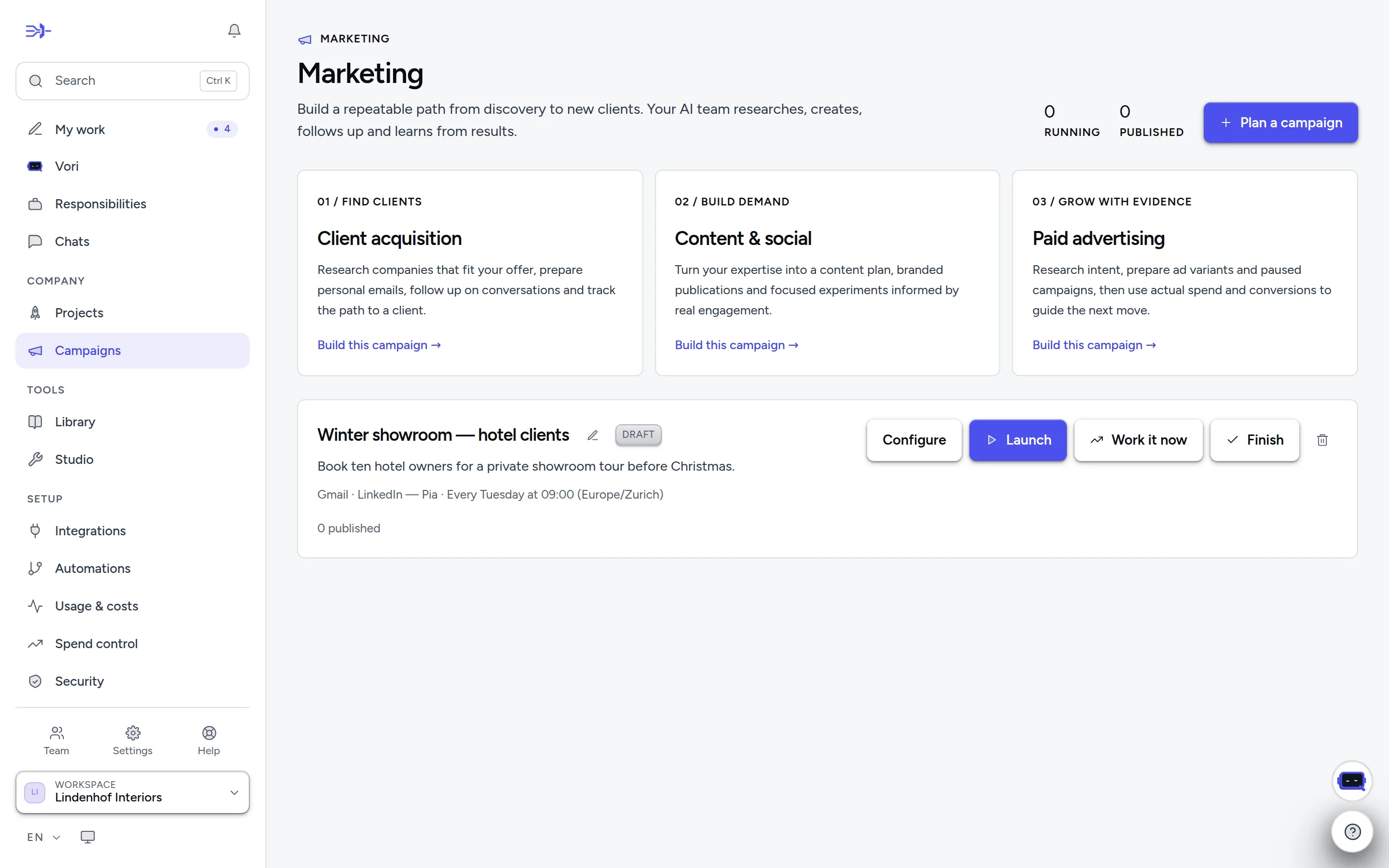
- 1Three playbooks — client acquisition, content & social, paid advertising.
- 2“Plan a campaign” builds a custom one; it stays a draft until you launch it.
- 3“Launch” arms the cadence; “Work it now” runs one cycle immediately.
Launch and follow it
Launch arms the cadence (owner, or whoever planned the campaign); Work it now runs one cycle immediately — each cycle is a billed run. Pause, Finish and Delete are on the card, and Show what was published lists every publication. Publishing follows your approval rules, and activating ad spend or changing a budget asks you separately by default. Paid channels show measured impressions, clicks and spend. If the schedule behind a campaign stops after repeated failures, the card says so — fix the cause and launch it again.
The prospect pipeline
View pipeline shows every prospect with its stage — discovered, qualified, draft prepared, contacted, replied, meeting booked, client won, not pursuing — its source and its next step. Work priority brings replies, meetings and due follow-ups forward. Add prospect records one by hand (saving sends nothing), Import CSV brings in up to 100 reviewed records at a time (existing prospects are skipped), and Export pipeline CSV downloads the whole pipeline. Stages are what your team reports — check the linked evidence for sends, meetings and wins.
Do not contact
Marking a prospect Do not contact applies to every campaign in the workspace, including future ones, and survives deleting the campaign. Campaign emails sent through Gmail or Outlook are checked against it at the moment of sending. Campaigns and opt-outs are part of the workspace export.
A Swiss market profile
Use a Swiss market profile sets the outreach languages (Swiss Standard German, French, Italian, Romansh, English) and target cantons (none selected means all of Switzerland). Every campaign cycle receives it. It guides research and drafts only: it sets no ad targeting and grants no permission to contact anyone — and a canton or a name never decides a prospect's language.