Responsibilities
A responsibility hands a standing business duty to one AI employee — keeping supplier invoices ready to book, turning enquiries into offers — on terms you set, with a record of everything it handles.
A task ends, a responsibility stays
A run is one piece of work and then it's over. A responsibility outlives its runs: it has written terms, a schedule that fires its cycles (each one a normal run), and a ledger of every real-world item it handled. So you can answer the questions a run can't: what has actually been handled, was anything done twice, what is it allowed to do — and was it worth it.
Delegate something
On Responsibilities, Delegate something walks through five steps: the outcome (what would you like to stop doing by hand?), the terms, the apps it needs, a test, and the hand-over. Swiss trades businesses can Start with one job: prepare offers from customer enquiries, prepare invoices for completed jobs, or the weekly office handover.
A saved job shows Your next step — finish the setup, run a rehearsal, review it, then activate. You can leave at any point and continue later. Vori can draft, test and activate responsibilities for you too.
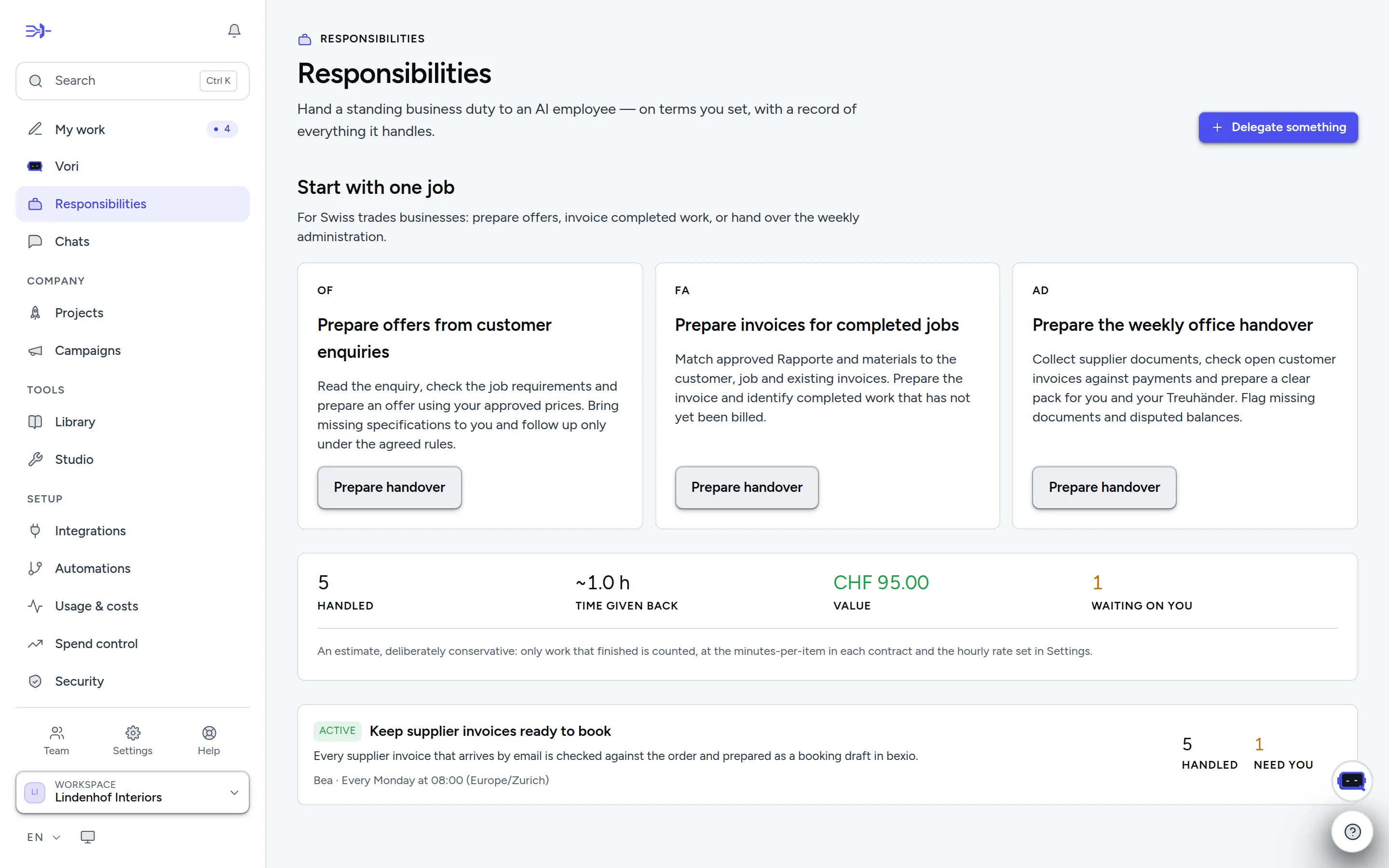
- 1“Delegate something” walks you through outcome, terms, apps, test and hand-over.
- 2Swiss trades businesses can start with one ready-made job.
- 3What your responsibilities handled — and an estimate of the time and money it gave back.
- 4Each responsibility: its status, its terms in one line, what it handled and what needs you.
Rehearse before you rely on it
A rehearsal is a real cycle with one difference: it reads your connected apps for real, but writes nothing to them — it records what it would have done. Without connected apps it works on clearly labelled sample data. Review the output and the proposed actions before you start the schedule. Rehearsals and scheduled cycles use your plan allowance and budget like any other work.
The terms
The terms say what the responsibility is for, what it may do, what it must never do, when it asks you, what you get, and when a cycle counts as done. Three clauses are enforced by the platform itself, not left to the employee: categories that are blocked outright, categories that always ask you first, and an amount in CHF above which it asks (if an amount can't be read, it asks anyway). The rest briefs the employee on every cycle; the card says which is which.
Change the terms: anyone can make them stricter; only an owner can widen them. Terms can only ever tighten what the Security page allows — never grant more.
Hand it over — and keep an eye on it
Hand it over (or Activate and run the first cycle) is owner-only and stays locked until the setup checks pass. From then on it runs on its schedule. Pause stops it without losing anything — any member can pause; Delete (owner) destroys its ledger. If its own cycles keep failing, the schedule pauses itself until you fix the cause and resume it.
What it handled lists every item with its outcome and proof: Handled, Confirmed (read back from the app after writing), Skipped (already handled in an earlier cycle, so not done twice), Waiting on you, and an estimated Value from the minutes per item and your hourly rate. Owners can record a completed week with the real workload, time and cost to measure the benefit. Vori's operating plan shows every responsibility's live runs, failures, open decisions and next cycle, with Pause future cycles.